The crossroads of the Hill — where the Peninsula shops, banks, rehearses, and rides. A city that wrote "rural character" into law, kept its bridle trails through every neighborhood, and still runs on horse time at its core.
Rolling Hills Estates incorporated in September 1957 — months after its gated neighbor — for the same reason every Hill city did: to control its own destiny while Los Angeles boomed below. Its founders wrote a general plan around a phrase residents still quote at council meetings: a rural community in an urban setting. White fences, equestrian overlay zones, and 25 miles of bridle trails made it policy.
Then geography made RHE something more. Because the city holds the saddle of the Hill — the natural crossing where Silver Spur, Crenshaw, and Palos Verdes Drive North meet — the Peninsula's shared life gathered here: Peninsula Center and the Promenade, the main library, the Norris Theatre, Peninsula High, and the South Coast Botanic Garden on the city's shoulder. Nearly everyone on the Hill passes through RHE most days, whether they notice the city line or not.
The result is the Peninsula's most interesting balancing act: a working equestrian town wrapped around a regional town center, now facing the Hill's biggest planning questions about what the aging Promenade property should become.
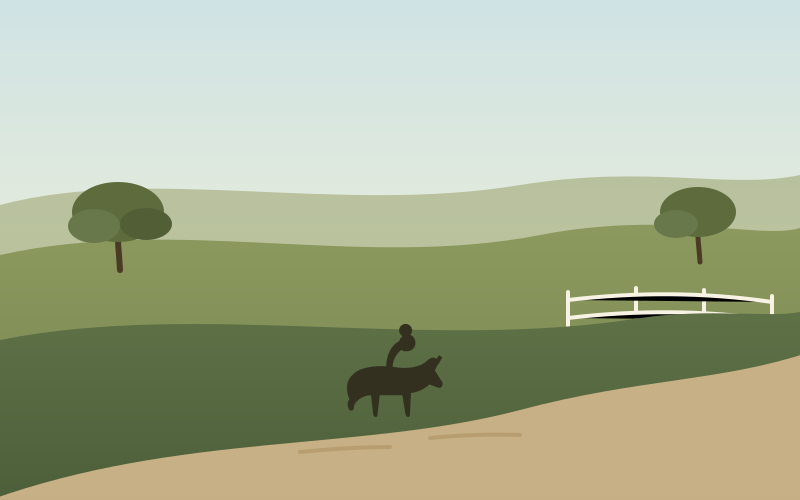
Original illustration for Palos Verdes Life
| Incorporated | September 18, 1957 |
| Population | 8,280 (2020 Census) |
| Land area | ≈ 3.6 square miles |
| Identity in law | "A rural community in an urban setting" — equestrian overlay districts and ~25 miles of city bridle trails |
| City hall | 4045 Palos Verdes Drive North · rollinghillsestates.gov |
| ZIP code | 90274 (Palos Verdes Peninsula / Rolling Hills Estates) |
| Schools | PVPUSD — Dapplegray & Rancho Vista Elementary, Ridgecrest Int., Peninsula High (in-city) |
| Police / fire | L.A. County Sheriff (Lomita Station) · L.A. County Fire |
The enclosed 1980s Promenade on the Peninsula mall is the Hill's largest redevelopment opportunity, and concepts mixing housing, retail, and open space have been moving through RHE's public process for several years — colliding with state housing mandates and resident concern for the city's rural character. It is the defining local issue of this decade. Where it stands →
In July 2023 a sudden canyon-edge landslide destroyed a dozen homes on Peartree Lane — a shock on a part of the Hill with no slide history, and a reminder that canyon-rim geology deserves respect everywhere on the Peninsula, not just at Portuguese Bend. Full background: pvlandslide.com.
Markers are approximate neighborhood centers, not legal boundaries. Corrections from residents welcome — tell us.
The Peninsula's downtown: the shops and restaurants of Peninsula Center, the Promenade and its Norris Theatre, the main Peninsula Center Library, and the medical and office life of Deep Valley Drive. Townhomes and condominiums around the center offer the Hill's most walkable living — a rarity worth knowing about for downsizers who want to stay on the Peninsula.
A gated equestrian enclave in the city's eastern quarter where the Rolling Hills aesthetic continues at a slightly smaller scale — board fences, barns behind the houses, and direct access to the bridle-trail network. One of the Hill's quietest addresses that still reaches Peninsula Center in five minutes.
The soul of equestrian RHE: streets named for gaits and tack, corrals in the side yards, and kids who learn to post before they learn to drive. Dapplegray Elementary and the Empty Saddle Club — the 1930s riding club that anchors the Hill's horse culture — are the neighborhood's twin institutions, with Ernie Howlett Park's arenas across the Drive.
The old Chandler quarry lands became the city's largest modern project: the rebuilt Rolling Hills Country Club with its David McLay Kidd course, ringed by a new generation of estate homes. It is the rare place on the Peninsula where you can buy new construction — and the views over the course to the basin explain the price of it.
Classic mid-century RHE between Palos Verdes Drive North and the hill: one-story ranches on generous lots, mature trees, trails at the end of the block, and Rancho Vista Elementary within bike reach. If you ask a longtime resident to describe "regular RHE," this is the picture they paint.
The city's western neighborhoods climb from Silver Spur Road toward the RPV line — a mix of ranch homes and townhome communities with basin and harbor glimpses, closest to Peninsula High and the morning coffee lines of Silver Spur's shops.
Along Crenshaw's descent sits one of America's great land-reclamation stories: the South Coast Botanic Garden, 87 acres of gardens grown over a former diatomite mine and county landfill since 1961. The garden — and the neighborhoods near it — mark the Hill's transition to the city below.
The Peninsula's performing-arts home since 1983 — Broadway series, concerts, and the youth conservatory next door.
87 acres of rose gardens, lake, and seasonal light shows atop reclaimed land — one of the region's best memberships.
The 1930s riding club that keeps the Hill's western traditions — gymkhanas, barbecues, and boarding under the pepper trees.
The flagship of the Palos Verdes Library District, and the Hill's de facto living room on a rainy day.
A sample of current RHE activity — the Real Estate page has the Hill-wide listings, map, medians, and market notes. Every property links to its page at properkey.us. Data powered by Properkey.
RHE offers the Hill's widest menu: equestrian properties with real horse rights, mid-century family ranches, townhomes near the center, and new construction at Chandler Ranch. Equestrian overlay rules, trail easements, and canyon-rim geology all shape value here — details a neighborhood-level broker reads before the offer, not after.
South Coast Botanic Garden · InSapphoWeTrust, CC BY-SA 2.0 · Real estate content by Properkey, CA DRE #01979718 · Equal Housing Opportunity