An island that joined the mainland, a rancho that became a dream city, a farming community the war took away, an oceanarium the world visited, and land that never stopped moving — the Peninsula's history is stranger and richer than its quiet streets let on.
For thousands of years the Peninsula's coves and springs supported Tongva (Gabrielino) communities — including the village of Chowigna at Malaga Cove, remembered today by a plaque near the site — who fished the kelp beds and traded across the channel to Pimu, Catalina. Shell middens along the bluffs still mark their long tenure.
Juan Rodríguez Cabrillo's expedition coasts the Peninsula — the first Europeans to record the smoky shoreline of San Pedro Bay.
After decades of Sepúlveda family occupation, José Loreto and Juan Sepúlveda receive formal title to the 31,000-acre rancho — "the green trees" — running cattle over the entire Hill. Drought, debt, and decades of partition litigation unwind the rancho within a generation — the courtroom carve-up that makes the Bixby purchase possible.
Azorean Portuguese whalemen build a shore station at the cove that takes their name, hunting migrating gray whales from small boats and rendering the blubber in great iron tryworks. Captain Frank Anderson's crews produce 2,166 barrels of oil from 1874 to 1877 before the station closes — California Historical Landmark No. 381, and the Hill's first industry.
Jotham Bixby acquires most of the Peninsula for sheep and cattle; dry-farming leases follow, and Japanese immigrant farmers begin coaxing beans, peas, and tomatoes from the terraced slopes.
New York banker Frank A. Vanderlip leads a syndicate that buys 16,000 acres — nearly the whole Hill — reportedly sight unseen. Walking the crest for the first time, he compares the coast to Amalfi and begins planning "a millionaires' colony" with the Olmsted Brothers landscape firm.
The Palos Verdes Project launches the great planned suburb: Olmsted Jr.'s land plan, Cheney's protective restrictions, the Art Jury, and sales brochures promising "the most fascinating and beautiful residential city in America." Malaga Cove Plaza, La Venta Inn, and the first villas rise through the decade.
Alongside the new suburb, some 200 Japanese-American families farm the Peninsula's slopes, hauling produce to the LA markets and building a deep community around the Hill. Executive Order 9066 ends it overnight in 1942: the families are interned, most losing their leases, equipment, and livelihoods. Most families' leases were never restored; only a handful — among them the Hatano and Ishibashi families — return to farm the coastal terraces after the war. For decades afterward, Annie's Stand, the little white produce stand Annie and Jim Ishibashi ran beside their fields on Palos Verdes Drive South near Abalone Cove, sold tomatoes, strawberries, and sweet corn to generations of Hill families — a beloved landmark into the 2000s, and the last working piece of the farming Hill. Their story is part of the ground here.
A. E. Hanson lays out the white-fenced ranch community along the crest for the Palos Verdes Corporation; the RHCA is born with it.
Palos Verdes Estates incorporates to defend the Project's plan and parklands through the Depression.
War brings radar and gun installations to the crest and, in the Cold War, Nike missile batteries — including site LA-55 at Point Vicente, whose grounds later became Rancho Palos Verdes' civic center. The radar domes on San Pedro Hill still watch the approaches to LAX.
The world's largest oceanarium opens on Long Point — killer whales, the "Sky Tower," Hollywood film shoots, and three decades of school field trips — until its new owner (SeaWorld's parent, Harcourt Brace Jovanovich) abruptly closes it in 1987, moves the orcas to San Diego, and demolishes the park — leaving Long Point empty for two decades.
County crews extending Crenshaw Boulevard reactivate the ancient Portuguese Bend landslide. About 130–140 homes are destroyed or displaced as the coast begins a slow-motion migration to the sea — and it is not the last reactivation: the Abalone Cove slide follows in 1974 and Klondike Canyon around 1980.
Rolling Hills (January) and Rolling Hills Estates (September) incorporate within months of each other, locking the equestrian Hill's character into law amid LA's postwar annexation wave.
Hill voters unify their school districts into what becomes PVPUSD, and Palos Verdes High opens on the bluff. Off Rocky Point, the Greek freighter Dominator runs aground in the fog; its rusting bones become the Hill's favorite macabre landmark for decades.
Facing county-approved plans for tens of thousands of new residents, coastal homeowners vote Rancho Palos Verdes into existence — the Hill's fourth and largest city, founded on open space.
The Palos Verdes Peninsula Land Conservancy (founded 1988) and the City of RPV assemble the Palos Verdes Nature Preserve — about 1,500 acres today, within roughly 1,700 the Conservancy manages Hill-wide — saving the coastal sage hills from the last great development push and bringing the PV blue butterfly back from presumed extinction.
After twenty years of debate over Marineland's ghost, the 102-acre resort opens — the Hill's biggest business and its new postcard.
Record rains accelerate the Greater Portuguese Bend slide complex to historic rates; Wayfarers Chapel — Lloyd Wright's 1951 glass sanctuary, named a National Historic Landmark in 2023, mere months before the ground forced its closure — is painstakingly dismantled for rebuilding, with Battery Barnes near RPV City Hall the intended site (not yet secured). RPV's dewatering campaign begins to slow the land. The Hill's oldest story, still being written.
The Hill's strangest true story: Christopher Boyce, a Peninsula-raised falconer working inside TRW's classified "black vault," and his childhood friend Andrew Daulton Lee sold spy-satellite secrets to the Soviets — caught in 1977, immortalized in Robert Lindsey's bestseller and the 1985 film with Timothy Hutton and Sean Penn. Boyce even escaped federal prison in 1980 and robbed banks before recapture. It all began in the quietest suburb in America.
After the war took nearly everything from the Hill's Japanese-American farmers, Annie and Jim Ishibashi came back and kept farming the coastal terraces — and their little white stand on Palos Verdes Drive South near Abalone Cove sold tomatoes, strawberries, and sweet corn to generations. When the stand finally faced demolition, the whole Hill mourned. Original illustration.
Golden Cove's clifftop landmark opened in 1966 and became the Hill's default celebration room — prime rib, ocean out every window, and a bar that watched three generations grow up. It poured its last in 2026, and the corner won't feel the same. Original illustration.
More lore lives on the city pages — the peafowl descended from a Vanderlip-era gift, the ghost stories of the lighthouse keepers, the Dominator's bones on the rocks. Know a tale we should keep? Send it in.
Frank A. Vanderlip, president of National City Bank, whose syndicate purchased 16,000 acres of the Peninsula sight unseen. Library of Congress, public domain.
Frederick Law Olmsted Jr., who shaped the Palos Verdes Project's land plan — parklands first, houses second. National Park Service, public domain.
Another original Palos Verdes Project sales piece — the promise, in the Project's own words. Public domain, via the Internet Archive.
An original Palos Verdes Project sales brochure — "Your home in Palos Verdes Estates" — from the campaign that filled the first villas. Public domain, via the Internet Archive.
When the Hill hosted the world's largest oceanarium, and every mailbox in America might hold a picture of Long Point. Public domain postcard.
The wrecked Greek freighter off Rocky Point, four years after grounding in the fog — photographed from the air by Robert J. Boser (CC BY-SA 3.0). Fragments remain in the surf today.
Lloyd Wright's glass-and-redwood sanctuary above Abalone Cove — the "Tree Chapel" — hosted seventy years of Hill weddings, earned National Historic Landmark status in late 2023, and was closed by the moving ground within months. Every beam and pane was catalogued and removed; the planned rebuild site is Battery Barnes beside RPV City Hall, about a mile west, though it is not yet secured.
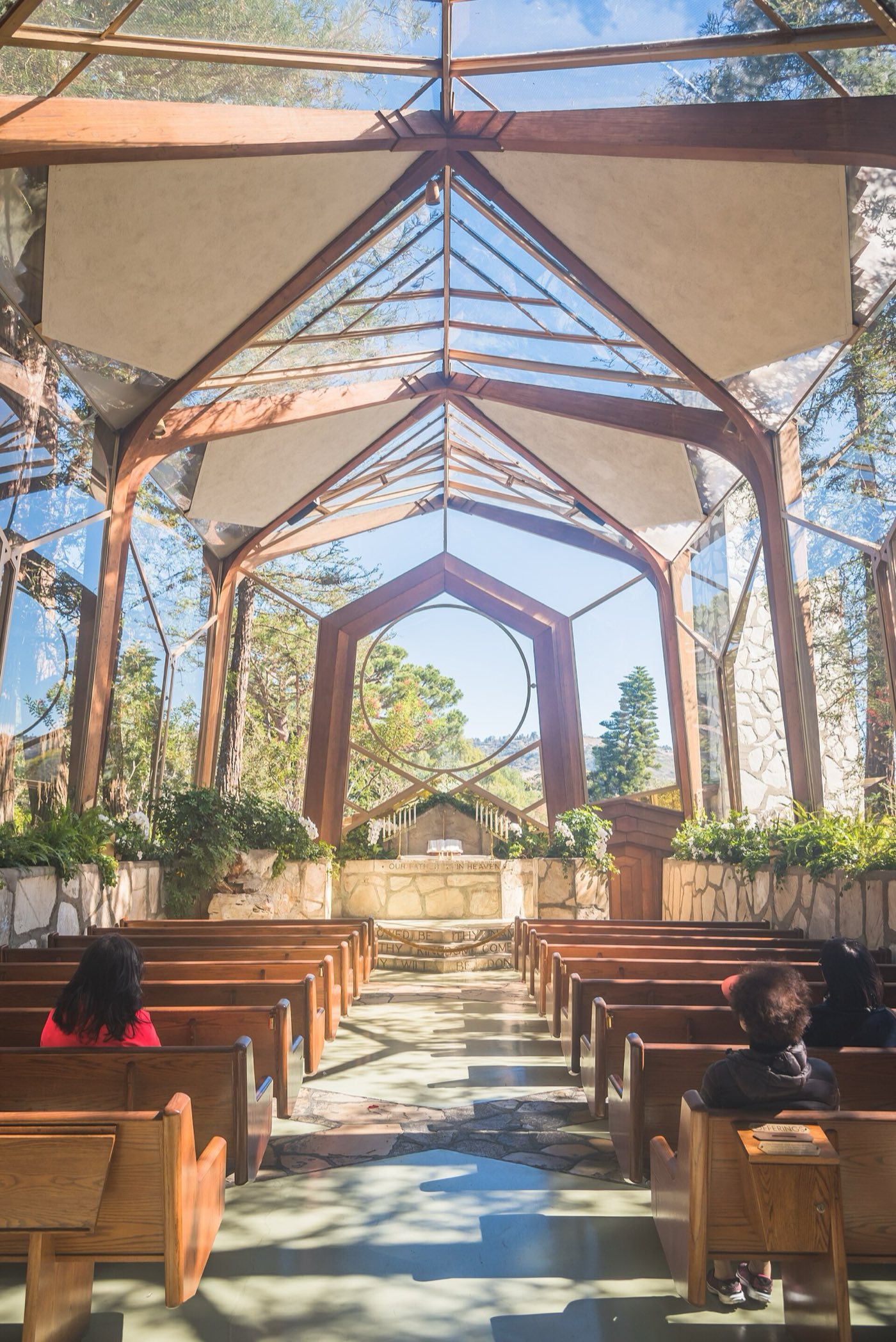
Wayfarers Chapel, 2018 · Sitao Xiang, CC BY-SA 4.0, via Wikimedia Commons
The Palos Verdes Library District's Local History Center at Malaga Cove holds the Project archives, photographs, and oral histories. pvld.org
The Hill's museum: geology, Marineland, whaling-era relics, and the lighthouse story, on the bluff where it all happened.
Each city guide carries its own timeline: RPV, PVE, Rolling Hills, RHE.