Not a news wire — a resident's briefing. These are the long-running stories that actually decide what the Peninsula looks, costs, and feels like, kept in plain language and updated as they develop.
What it is. The southern slope of the Peninsula sits on ancient landslide terrain — layers of slippery volcanic ash within the rock, tilted toward the sea. The Portuguese Bend section reactivated in 1956 during county road construction and has crept ever since. It is the largest continuously moving urban landslide in North America, and it is the defining fact of life for the neighborhoods above it.
What changed. Two historically wet winters in 2023 and 2024 soaked the slide planes, and movement accelerated from inches per year to — in the worst sections — several feet per month. The consequences came fast: buckled sections of Palos Verdes Drive South, broken utilities and shutoffs in parts of Portuguese Bend and Seaview, the closure and careful dismantling of Wayfarers Chapel, federal disaster assistance, and voluntary FEMA-funded buyouts for the hardest-hit properties.
What's working. Rancho Palos Verdes drilled a network of deep dewatering wells to pump water off the slide planes — more than 500 million gallons removed since fall 2024 — and the results are real. Per the city's August 2026 survey (as tracked at pvlandslide.com), average movement in the still-active areas fell to 0.99 inches per week — under an inch for the first time since October 2023 — with the Portuguese Bend slide itself down 92% from its peak. That milestone matters practically: it puts the complex-wide average below SCE's stated threshold for discussing re-energization — though the caveats matter. Abalone Cove was still moving 1.29 inches per week in August, above that line, and SCE's criterion is movement near its own infrastructure, not the complex-wide average. Seaview and the Portuguese Bend Beach Club already have power restored; the Portuguese Bend Community Association area is the neighborhood still on solar and generators. Twenty-seven homes have accepted FEMA-backed voluntary buyouts so far, with a third round awaiting federal decision, and winterization work continues each fall.
What it means for residents and buyers. The active zone is a defined area — most of RPV, and the vast majority of the Peninsula, sits on stable ground. But near the south coast, geology is the first question, not the last: moratorium zones, insurance, lending, and disclosure all turn on it. Get the geotechnical report, and get local advice that has walked the parcel.
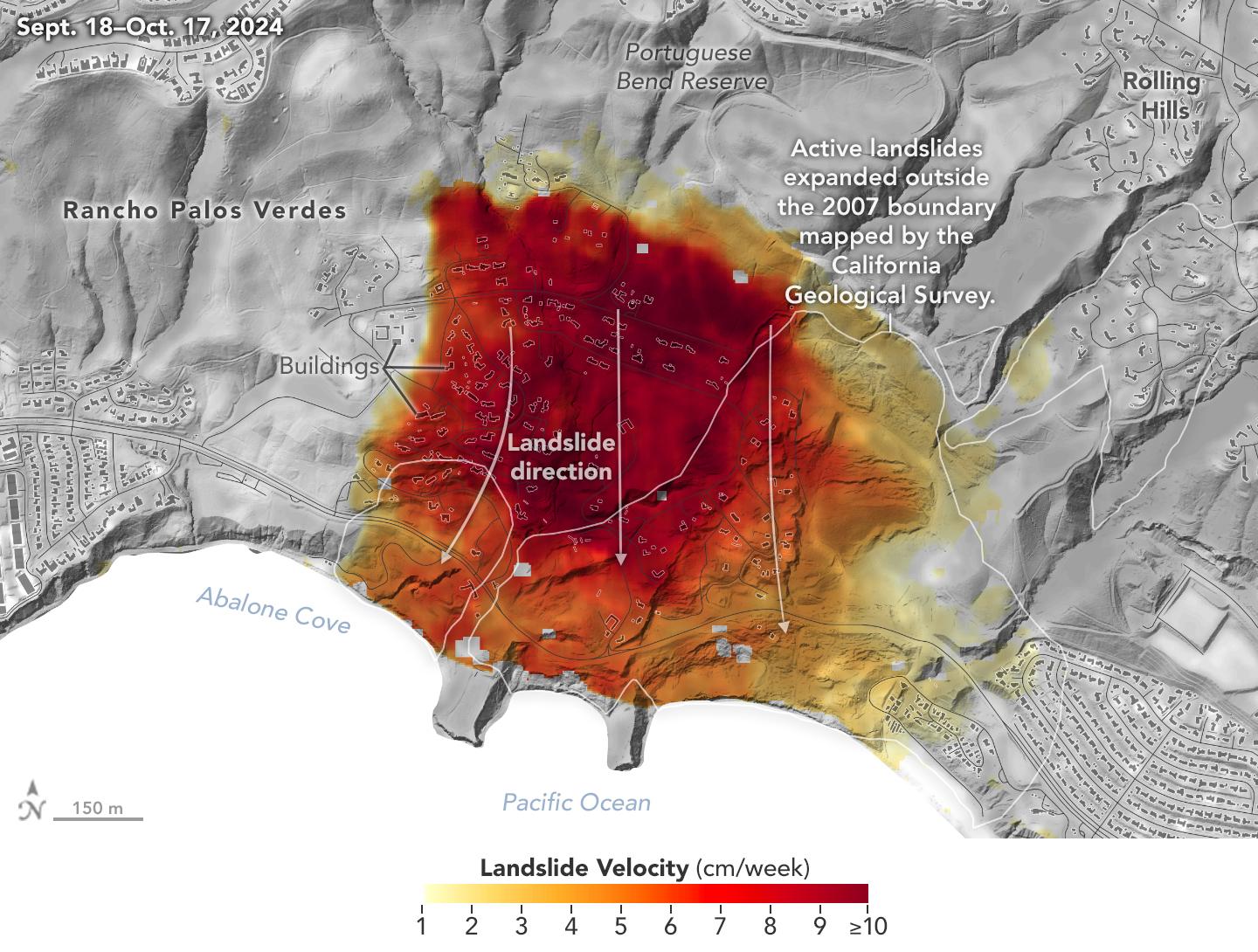
NASA airborne radar mapping of slide velocities, fall 2024 · NASA Earth Observatory, public domain
For depth, pvlandslide.com is the independent hub for the whole story — dated updates, maps & survey data, a resident & homeowner guide to every assistance program, and a tracker of every peninsula landslide so no event gets confused with another. Official source: RPV's land-movement portal.
This page is the summary. For the running record — dated movement data, meeting recaps, official reports, utility status, buyout programs, and a guide to every resource available to affected residents — go to the Hill's dedicated, independent landslide hub.
The Hill's real planning story is the housing now moving through Rolling Hills Estates' process around Peninsula Center: a 454-unit mixed-use project at 615–855 Deep Valley Drive (working through a supplemental EIR) and 90 homes at the Peninsula Shopping Center on Norris Center Drive, entitled in December 2024. Together they would be the largest residential additions on the Peninsula in decades — reshaping traffic, schools, and the town center itself.
The enclosed mall's 2008-era housing-over-retail concept was denied long ago; since its 2022 sale the property has leaned into entertainment tenants instead — bowling, family attractions, and more planned into 2026. State housing law (RHNA) is the accelerant behind all of it: large commercial sites are where mandated units pencil. Follow the dockets at RHE's planning pages — the story advances there, not on social media.
PVPUSD projects about 9,848 students for 2026–27 — the demographic slide continues, driving facilities questions and budget trade-offs even as programs grow (Lunada Bay's Spanish dual-immersion adds a second kindergarten class this year). The Peninsula Education Foundation's annual campaign matters more each year. Our schools guide →
Each city must zone for its state-assigned share of new housing. On a peninsula defined by open space, slide zones, and single-story covenants, finding compliant sites is genuinely hard — and the compliance choices (granny flats, mixed-use corridors, the Promenade) will quietly reshape parts of the Hill.
The sudden July 2023 landslide that destroyed a dozen Rolling Hills Estates homes above a canyon — on ground with no slide history — pushed drainage, irrigation, and slope-monitoring practice up every Hill homeowner's list. If your lot backs a canyon, an occasional geotechnical checkup is cheap insurance. Background on Peartree and every other peninsula slide: pvlandslide.com's peninsula-wide tracker.
Coastal sage and canyon fuel make the Peninsula a very-high fire-hazard zone. Brush clearance is enforced each spring; residents should register every phone with Alert SouthBay (or text ALERTRPV to 888-777), know two routes off the Hill, and keep the go-bag honest.
Coyote activity cycles with the seasons — small pets stay in at night, period. The Hill's famous peafowl (descendants of the Vanderlip flock) are beloved, loud, and formally managed by several cities through relocation programs. Both are permanent residents; plan accordingly.
The Portuguese Bend Community Association area remains de-energized while SCE talks proceed; the bicycle/motorcycle prohibition on PV Drive South was extended another 60 days on September 15 along with the local emergency; and a third FEMA/Cal OES buyout round (~8 homes) awaits federal decision. The running record: pvlandslide.com/updates.
Rolling Hills Estates broke ground on a rebuilt nature center at the George F Canyon trailhead in 2026, with opening targeted around summer 2027 — the east side's canyon walk gets a proper front door.
The gray whale migration streams past the Peninsula each winter, with the volunteer census counting from the Interpretive Center bluff daily. The season's first sighting is the Hill's own little new year. Guide →